Plants in the Classroom
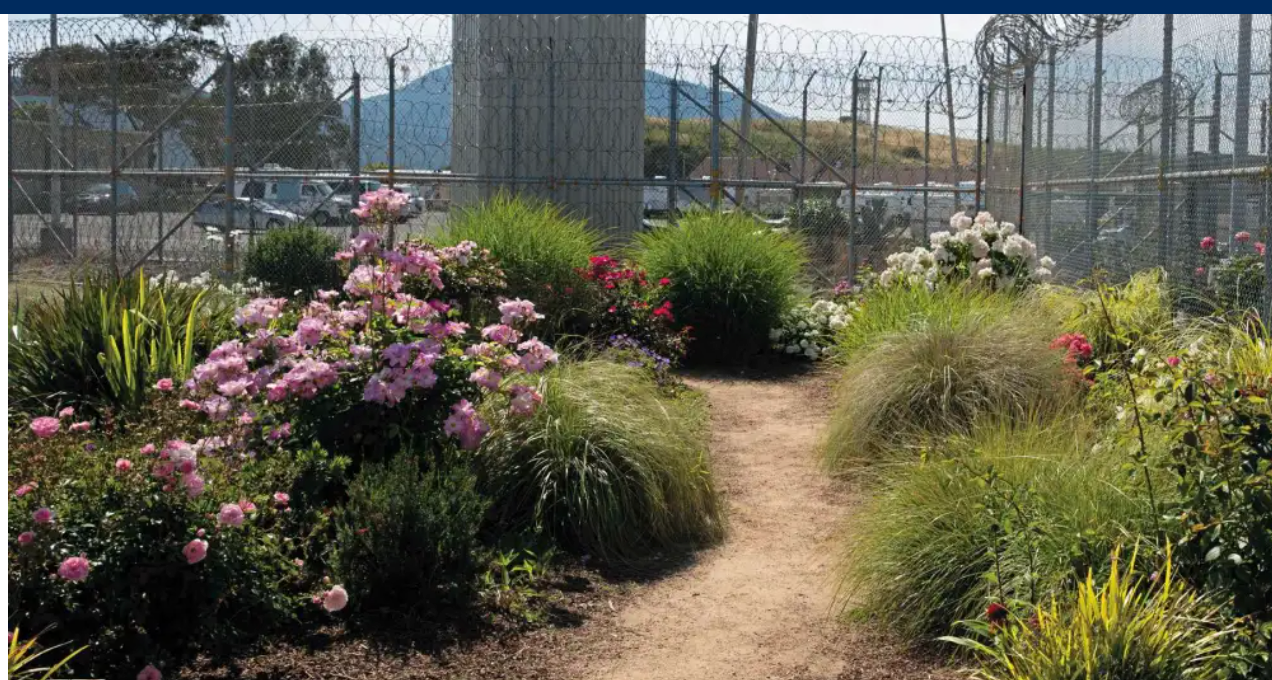
I taught at what was then called Prison University Project at San Quentin for 5 consecutive years. Much of that time was one-on-one tutoring in study hall, but this piece is about a day in my first full-length literature class, which I co-taught with a brilliant Black male instructor. (Lucky for me! Because most of the volunteers were white, and almost never Black men, and this is another rabbit hole and there are a lot of reasons for this. I'm not mentioning my co-teacher's name because we are out of touch and I don't have his consent. We had to work closely together through email but were almost never in the classroom together, we taught on separate days of the week.)
This is a volunteer position and most of the people who did it at that time were retirees who were there forever or UC Berkeley students who tended to teach classes for a shorter period of time. It is a huge sacrifice of time, minimum 5 hours each time you visit because of going through security/driving. Not the most logical choice for someone like me who had a very low income and no intergenerational wealth. I felt more similar to the students than my colleagues. Class orientation is a doozy. But it had a lot to do with orientation to the program. Sometimes it was detrimental to students, sometimes it wasn't. (Ask them.) But I mention this to say that intersectionality matters. Having a variety of perspectives matters.
I felt reluctant to release this writing, because I don't have the students' consent either. There was a lot of talk about the ethics of releasing this kind of writing. I don't know where I stand. I know many people in this class were released. Some may still be in the system. It was just one of the most important experiences of my life, so I want to share it in order to honor their wisdom. I was in contact with a few people after I left the program, but if you are in the program you can't correspond with people who are incarcerated, or you will get kicked out.
Thank you to my friend Rebecca Vandevoort for being the one who convinced me I could do it, even without a car, as they had carpools! And some of the staff members at the time, Allison, Amy, and Heather, were incredibly encouraging while navigating the boundaries of that other dimension/co-universe that is prison.
[Begin.]
Plants in the Classroom
After a particularly difficult week, after the height of not feeling heard, when it seemed like no one was doing the assignments, and the drafts were due but only half came in, I decided to take a break in the literature and start class by listening to a podcast.
We listened to a podcast on how plants think, (podcast link at end of this post) while I plowed through handing out missed assignments and graded homeworks, which felt really good.
I proposed that we are "being plants today, and not ourselves" and how it was important to consider other types of being, and how writing represents that.
There were so many interesting plant ideas, from how people at San Q relate to plants, the inmate who sings to plants as he tends them, says Kean, and Kell talked about caring for office plants, Char mused, what do the thinking of collard greens and tomatoes sound like?, Merl wrote a poem about a palm tree (the one outside the classroom), then we talked about the different kinds of motivations or tendencies of "thinking" that plants might have, as opposed to animals, humans.
The podcast was very scientific, explaining how this one plant constantly flinches as it is dropped a few inches, but then "learns" to stop flinching. (An adorable moment when Aron said it made him sad they kept dropping the plant.) Or how plants "hear" through roots, as the podcast said the roots would even go for the recorded sound of water, & be tricked!!
Gerald is also really interested in science, and had some good reflections on what the experiments might mean. Ben said something about how we all come from the ocean, which was very beautiful and I said, did you read that in a book, or do you just believe that somewhere inside you? He wasn’t sure.
Kean said something about how we all come from salt water, because of the womb and tears. And Joaquin said he comes from Mexico but he believes we come from dirt and earth. Devon said something very bizarre about how he thought I was trying to brainwash him through the podcast, but he was writing his paper the whole class period. Then Devon wants to say something but then feels uncomfortable and doesn’t. But Devon did say something nice about how we are all made of the same atoms. And I nudged on Ben to speak, but he said he didn't like to be nudged.
We were pointing toward other authors I assigned who might inhabit worlds very different from their own, or my own, or even how the structure of consciousness of their worlds might be different. So we were very able to shift over into Humanimal by Bhanu Kapil about real wolf-girls found in the 1920s. We only scratched the surface of it, but I handed out the attached bios and a chart in which I gave reasons for why I chose what I chose and how things might fit in with others.
There is also "Sick Woman Theory" that I proposed might be the polar opposite of thinking about life than what they may believe/ be living in /be proximal to now, because the theory is very anti-biological determinism, anti-identity in a lot of ways, while those types of thinking are hyper-imposed on to them in the place where they are. They seemed receptive to it, because I think they understood the author's intention is that people care for each other, radically across groups. What they are dealing with in there is having to clearly choose a race or “Other” upon entry into prison if that race is not “clear” to officials. Orientations around sexuality or gender are blocked, trans people are isolated, and many accounts I’ve heard of people in prison describe that being gay does not exist, which cannot be true in behavior or mind, but it is true in public identity. It seems like it cannot exist.
The time that Ben spoke up for people who are mentally ill on the yard, and how they were being separated.
The day that Merl read the palm tree poem.
The day that Merl said A and him were the grumpy old guys on the Muppets.
The day that both Carl and Jamal quoted Planet of the Apes. “Take your hands off of me, you stinking ape!”
Morris and Chi always sitting together.
When Ben said that we came from the ocean.
When Joaquin read his essay aloud and the main topic was that he would never be able to connect to another person.
When they brought up Superman, or Thor, or the main character, some superhero, almost all the movie examples chosen were superheroes.
When the room started reading the poem “Brazilian is not a Race” by Wendy Trevino, skipping from person to person seamlessly, I didn’t have to call on them, they just went.
When Gerald said that Steve Orth in the poem took acid.
Kean making an announcement that there was going to be ice cream.
When Jo said that Hard Rock was the kind of guy who did the bad things everyone wanted to do, and now it was time to take care of Hard Rock. (from “Hard Rock Returns to Prison” by Etheridge Knight)
I’ll miss the way you fist bump one another coming to class, or pat each other’s shoulders.
Why do teachers come here? For me, I’ve always been most comfortable on the bus, talking to people on the corner, just bullshitting, having casual speech exchanges. I am not as interested in the cell-phone obsessed youth I hear of in my friends’ college classrooms. I went to college in 1997-2001. When I met a bunch of students in San Quentin’s study hall, where there is more space to talk one-on-one, I realized that many of them have been in prison since then. The world they remember was the one when I was in college.
And I think of my semi-hooligan past, and the trouble I was in and what I was running from, and I understand. I thought I was invincible then. I had friends that did not make it out. The college dorm I moved into had students shooting up in the dorm rooms. There was a loud school bell that went off every time the street light changed, off of Broad Street, right outside my bedroom. I was a strange girl. I would borrow a flattening iron from the Black girls down the hall. My roommate was from Sierra Leone and she would tell me how she was made fun of by other Black people for being too black. My first poetry teacher was Sonia Sanchez and we would hold hands in a circle at the end of class, and back then I could never figure out why she wore a 2PAC hat. My city life was freedom from my erratic and terrifying childhood. I didn’t necessarily want to go to college, but I went because I didn’t know where else to go and I needed to get away, and it was the best way I knew to get out of the house.
My needs were never primary to my family, just sometimes. And I always ate and had clothes.
The day of the Octavia Butler story: “The Evening, the Morning, and the Night” when everyone gave their take on what it would mean “to tear at one’s own skin.” (This is presented as a literal, scientific illness called Duryea-Code Disease.) They got it right away: there were answers flying around the room about addiction, self-loathing, a literal disease, heredity, ancestral lineage...this story ( or “novelette”) was definitely a gift of interpretation and reflection to anyone who’s struggled a lot with making life livable. The character in the story is also encountering college. “I can’t say why I went to college—except that I had been going to school all my life and I didn’t know what else to do.”
When Morris described Paid in Full in detail.
The focus on care
You know when someone is acting out they need more caring.
When Ani finally read aloud.
I learned that no person is what I expect them to be.
That nothing comes from nowhere.
I learned that most of my insecurities are internally induced.
I learned that it is possible to change perspectives.
Dear students,
I learned that empathy is different here, that courtesy is different, that the codes of living here are something to be respected.
I was reminded of something I once knew, that nothing comes from nowhere. No pain comes from nowhere, no action comes from nowhere. I believe that the problems of the world are rooted in deep wounds in how things are structurally set up. I believe we can find new ways of being. I believe that a classroom is a sort of relationship.
I believe that I didn’t achieve a lot of the goals that I wanted to achieve. But I will never forget any of you. I hate that some of you were moved somewhere else on some bus. You are so inspiring in your achievements. I imagine running across the Richmond Bridge with all of you. Running toward whatever is good.
I never felt like I could finish an entire lesson. I didn’t know if it would be confusing.
There were so many things I wanted to cover that I could not cover.
I wonder if we helped you make more complex sentences with the exercises we were using or not.
I wonder if the free writes were mistakes in that they were too personal, or if they actually helped you to release something in a helpful way.
I wish, I wish I had a steady income so I wasn’t so stressed out and I could help you more. I feared that I would make some pain emerge too intensely by the questions I asked. I had underestimated how you would help each other.
I wish I could have done a million creative things.
I felt like Octavia Butler was talking to me through dreams during much of the course. I would sit in the living room crying that she was talking to you.
I didn’t want you to hear any more violence because you had all dealt with so much, I didn’t want you to deal with more stuff. I am thinking specifically of my coteacher assigning “Going to Meet the Man” by James Baldwin which describes a public, celebratory lynching of a black man by the white people in town, a scene more common than I was ever taught. My friends who were more experienced teachers said “you have to trust the students with the material” and they were right, but I also know how trauma works, how some incident can bring up all kinds of things and I guess I thought there would not be a way to have a support or an outlet, but of course, you found a way to support each other, you found a way to care for each other, you stood up for your own classroom.
I understand the type of space where anger shows up out of nowhere, I understand what it is to be pitted against your peers, and I at least knew how not to do that. I think.
You felt as if you could disagree with one another, and still listened, and that was ok. When you get out, and I think you will, will you know who to find to let you into the world? What would you want from that space?
I felt that, especially in the beginning, I wasn’t as respected as my male co-teacher, but I also wondered if my own thoughts made me not take myself as seriously or believe in myself as easily.
I saw growing confidence, I saw growing sophistication. I saw following forms and outlines, and I saw the courage to break out of forms and outlines.
I went to the training given by graduates of the program. I believe it came out of frustration that the teachers teaching them often knew very little about the conditions of their lives, the arbitrary rules and counting that ruled how their days moved, the system of points that measures how close they are to getting out, and things that can influence it. (For example, taking programs such as the college program or getting married lowers the amount of points in the severity of your sentencing, which means you are closer to getting out.)
I wanted to find out how we could help each other.
One of the best feelings might be reading aloud together.
I would have asked for more help. I would have been more brave and forceful in advocating for myself.
I would have made things clearer.
What are you most proud of, inside of class? What are you most proud of, outside of class? What would you have changed?
Write a letter to an object in the classroom. What did the object see?
If there was a big eye in the classroom, what would it have seen that it liked?
Would you like to talk about next semester?
Podcast referenced: